Free PDF Amplifying Your Effectiveness: Collected EssaysFrom Brand: Dorset House
Yeah, investing time to review guide Amplifying Your Effectiveness: Collected EssaysFrom Brand: Dorset House by on the internet could likewise provide you good session. It will certainly relieve to talk in whatever condition. In this manner can be more fascinating to do as well as less complicated to check out. Now, to obtain this Amplifying Your Effectiveness: Collected EssaysFrom Brand: Dorset House, you can download in the web link that we offer. It will certainly aid you to obtain very easy way to download the e-book Amplifying Your Effectiveness: Collected EssaysFrom Brand: Dorset House.
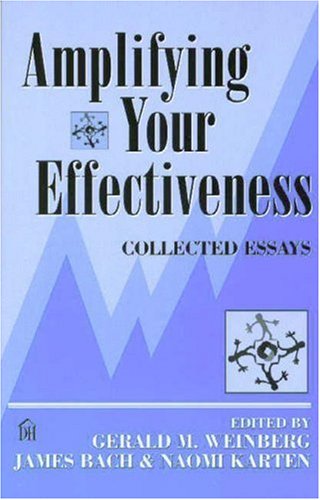
Amplifying Your Effectiveness: Collected EssaysFrom Brand: Dorset House

Free PDF Amplifying Your Effectiveness: Collected EssaysFrom Brand: Dorset House
Amplifying Your Effectiveness: Collected EssaysFrom Brand: Dorset House. Is this your leisure? What will you do then? Having extra or spare time is extremely amazing. You can do every little thing without pressure. Well, we expect you to save you few time to review this publication Amplifying Your Effectiveness: Collected EssaysFrom Brand: Dorset House This is a god publication to accompany you in this free time. You will not be so tough to understand something from this publication Amplifying Your Effectiveness: Collected EssaysFrom Brand: Dorset House A lot more, it will aid you to obtain much better details as well as encounter. Even you are having the great works, reading this book Amplifying Your Effectiveness: Collected EssaysFrom Brand: Dorset House will not add your mind.
As one of the book collections to propose, this Amplifying Your Effectiveness: Collected EssaysFrom Brand: Dorset House has some strong reasons for you to read. This book is very ideal with exactly what you need currently. Besides, you will certainly additionally enjoy this publication Amplifying Your Effectiveness: Collected EssaysFrom Brand: Dorset House to review due to the fact that this is among your referred publications to review. When getting something brand-new based upon experience, entertainment, as well as various other lesson, you can use this publication Amplifying Your Effectiveness: Collected EssaysFrom Brand: Dorset House as the bridge. Starting to have reading practice can be undergone from various methods and also from variant sorts of books
In checking out Amplifying Your Effectiveness: Collected EssaysFrom Brand: Dorset House, currently you might not also do conventionally. In this contemporary period, gadget as well as computer will aid you so much. This is the moment for you to open up the gadget and also remain in this site. It is the ideal doing. You could see the link to download this Amplifying Your Effectiveness: Collected EssaysFrom Brand: Dorset House here, cannot you? Merely click the link and also make a deal to download it. You can get to acquire guide Amplifying Your Effectiveness: Collected EssaysFrom Brand: Dorset House by online and also ready to download. It is quite different with the standard method by gong to guide establishment around your city.
However, reviewing the book Amplifying Your Effectiveness: Collected EssaysFrom Brand: Dorset House in this website will lead you not to bring the published book almost everywhere you go. Simply save the book in MMC or computer system disk and they are offered to read any time. The flourishing system by reading this soft data of the Amplifying Your Effectiveness: Collected EssaysFrom Brand: Dorset House can be introduced something brand-new habit. So currently, this is time to show if reading could improve your life or otherwise. Make Amplifying Your Effectiveness: Collected EssaysFrom Brand: Dorset House it undoubtedly work as well as obtain all advantages.
Gerald M. Weinberg, James Bach, Naomi Karten, and a group of successful software consultants present powerful ideas on how software engineers and managers can amplify their professional effectiveness -- as individuals, as members of teams, and as members of organizations.
The collected essays address diverse topics in personal empowerment, interpersonal interaction, mastering projects, and changing the organization. Contributors include James Bach, Marie Benesh, Rick Brenner, Esther Derby, Kevin Fjelsted, Don Gray, Naomi Karten, Bob King, Pat Medvick, Brian Pioreck, Ken Roberts, Sharon Marsh Roberts, Johanna Rothman, Steve Smith, Eileen Strider, Gerald M. Weinberg, and Becky Winant.
The idea for this collection arose out of a brainstorming session for the Amplifying Your Effectiveness Conference (AYE), which debuted on November 6-8, 2000, in Scottsdale, Arizona. Like the book, the annual conference is designed to help technical people become more effective individually, within a team, and within an organization. The contributing authors served as hosts of the inaugural AYE Conference.The variety of techniques and perspectives represented in the book will help you amplify your effectiveness -- whether or not you are able to attend the live event.
- Sales Rank: #144224 in Books
- Brand: Brand: Dorset House
- Published on: 2000-01
- Original language: English
- Number of items: 1
- Dimensions: .45" h x 5.50" w x 8.44" l, .50 pounds
- Binding: Paperback
- 160 pages
- Used Book in Good Condition
Review
"Successful software consultants present powerful ideas on how software engineers can be more effective." -- SciTech Book News
About the Author
A highly influential lecturer and consultant, Gerald M. Weinberg is author, coauthor, or editor of fifteen Dorset House books.
Tester, developer, speaker, consultant, and writer James Bach is founder and principal of Satisfice, Inc., based in Front Royal, Virginia.
Popular speaker and consultant Naomi Karten offers people-oriented perspectives and practical techniques. She is the author of Managing Expectations and editor of a newsletter, Perceptions & Realities.
Excerpt. © Reprinted by permission. All rights reserved.
Gerald M. Weinberg Introduces the Four Parts:
Although "organizational change" is a comforting executive concept, Virginia Satir, the great family therapist, was fond of reminding us that "change happens one person at a time." As the essays in Part One demonstrate, there is no organizational change without individual change, no organizational effectiveness without individual effectiveness.
A recurring dream of technical workers is to have the opportunity to work in perfect isolation. For better or worse, though, the vast majority of technical work puts us in relationships with other people. So, as Part Two reveals, if we are to amplify our effectiveness, we must learn how to amplify the effectiveness of our interpersonal interactions.
Projects are team efforts aimed at bringing something new into the world, which makes them sensitive measures of our individual and team effectiveness. To paraphrase an ancient Chinese proverb, managing a large project is like boiling a small fish -- a delicate job. The essays in Part Three explore a master’s techniques.
Once we have succeeded in demonstrating our effectiveness by successfully completing a project or two, our aspirations naturally turn to helping others do the same. But change is not the simple linear process that we might hope for, as the essays in Part Four illustrate.
Most helpful customer reviews
1 of 1 people found the following review helpful.
Diverse collection of software consulting essays
By Erik Gfesser
This book is a collection of "pre-cedings" written by 17 software consultants for a conference of the same name. In the introduction, Weinberg explains the frequent ineffectiveness of proceedings typically distributed at the end of conferences. These essays (the entire text is less than 150 pages) present a preview of the hosts participating in the first "Amplifying Your Effectiveness" conference by demonstrating the diverse styles and interests of the authors. Weinberg explains that within any organization, improvements in effectiveness can occur at three levels - the individual ("the Self"), the team ("the Other"), and the organization as a whole ("the Context") - and that this collection attempts to address all three levels. In addition, there are three fundamental abilities that contribute to the effectiveness of a manager or any other technical leader: "the ability to observe what's happening and to understand the significance of your observations", "the ability to act congruently in difficult interpersonal situations, even though you may be confused, or angry, or so afraid you want to run away and hide", and "the ability to understand complex situations so you can plan a project and then observe and act so as to keep the project going according to plan, or modify the plan". These three abilities are also addressed in this collection because the least developed among them prevents one from amplifying effectiveness the most.
The essays are presented in four parts: "empowering the individual", "improving interpersonal interactions", "mastering projects", and "changing the organization". Based on the number of dog ears following the reading of this book, this reviewer especially enjoyed parts one and four, and essays "Do I Want to Take this Crunch Project?" by Sharon Marsh Roberts and Ken Roberts, and "Modeling Organizational Change" by Esther Derby. In the first, Roberts and Roberts draw a distinction between "crunch projects" and "pseudo-crunch projects" and how to navigate the circumstances surrounding each type of project. While Edward Yourdon's "Death March" (see my review) discusses crunch projects at length, the authors here simplify the definition of crunch project by explaining that these types of project exhibit two requirements or constraints: (1) "there are major negative consequences if the project's deadline is not met", and (2) "given the constraints of the project, the allocated resources (time, money, or people) are significantly smaller than those required to fulfill the needs of the sponsor and the customers". The ability to distinguish between the crunch project and pseudo-crunch project is important because commensurate recognition is awarded to those who complete crunch projects, but few will acknowledge efforts of the team toward a pseudo-crunch project. Not only do pseudo-crunch projects typically exhibit "pseudo-deadlines" where internal management picks a date, but there are no significant impacts on profits or external relationships if the date is missed, pseudo-crunch projects bring by their very nature personal loss and no balancing gain.
In "Modeling Organizational Change", Derby explains that when a problem exists in the way a work group functions, confronting that problem necessitates organizational change, and "by taking a critical look at your process and using some theories from organizational design, you can fix that problem - and improve your organization's ability to deliver high-quality results". Because even small systems are very complex, any action in this regard can affect more than one variable in the system, so understanding the interplay of these factors and identifying the manner in which one desires to guide the system in a particular direction are important when designing organizational change. The relatively simple examples that Derby provides to explain circular causation and corrective action are written well, and the example and accompanying diagrams that she walks through are effective in explaining her points. Other essays that this reviewer especially enjoyed were (3) "Solving Other People's Problems" by Don Gray, where the author explains "The Pause Principle", "The Pay Attention Principle", "The Partnership Principle", "The Passion Principle", and "The Person Principle", (4) "The Perils of Parallel Projects" by Johanna Rothman, where the author discusses context switching alongside a table from Weinberg's "Quality Software Management, Volume 1" that exhibits data on how much time is truly available to an individual splitting their time across multiple projects, and (6) "Life as a Software Architect" by Bob King, where the author offers a discussion of the software architect role that explains what helps him avoid what he calls the "technical trap" - three metrics called "The Visibility Ratio", "The Conflict Metric", and "The Anxiety Metric".
1 of 1 people found the following review helpful.
Quick and Informative read for Software Professionals
By Chris Kenst
As the name implies Amplifying Your Effectiveness is a collection of essays edited by Gerald Weinberg, James Bach, and Naomi Karten created as a preceding to the conference of the same name. The AYE conference was created by a group of conferencing-going software consultants who felt the traditional approach was ineffective, built for academics, marketing companies, etc. This new conference would focus on improving or amplifying effectiveness of the participants on three levels: the individual, the team and the organization.
The book itself focuses on introducing the authors (hence the preceding) and their topics that cover four divrse areas of people effectiveness problems: Empowering the Individual, Improving Interpersonal Interactions, Mastering Projects and Changing the Organization.
My reason for reading this book was to focus on the articles written by James Bach and Jerry Weinberg for their relevance to software testing. As it so happens James Bach writes two essays on testing: The Role of Testing and Good Practice Hunting. Jerry Weinberg writes one essay about teams: Congruent Interviewing by Audition.
At 135 pages (excluding Bios) it's definitely worth picking up and scanning through at your leisure. Quick and informative read on people-oriented challenges for software engineers.
10 of 11 people found the following review helpful.
Recommended for your project-management shelf.
By Conrad H. Weisert
In the preface, the editor explains that this collection of essays arose from a "brainstorming session for a conference of the same name." As you'd expect with over a dozen authors, the results are uneven. If you're involved in software development, the following chapters will justify your purchase of the book:
- Don Gray: "Solving Other People's Problems"
- S.M. & K. Roberts: "Do I want to Take This Crunch Project?"
- Gerald Weinberg: "Congruent Interviewing by Audition"
- Johanna Rothman: "It's Just the First Slip"
Although the critical reader may find some other sections offering commonplace or occasional misguided advice, the whole book is stimulating and easy to read in one sitting. Recommended for your project-management shelf.
Amplifying Your Effectiveness: Collected EssaysFrom Brand: Dorset House PDF
Amplifying Your Effectiveness: Collected EssaysFrom Brand: Dorset House EPub
Amplifying Your Effectiveness: Collected EssaysFrom Brand: Dorset House Doc
Amplifying Your Effectiveness: Collected EssaysFrom Brand: Dorset House iBooks
Amplifying Your Effectiveness: Collected EssaysFrom Brand: Dorset House rtf
Amplifying Your Effectiveness: Collected EssaysFrom Brand: Dorset House Mobipocket
Amplifying Your Effectiveness: Collected EssaysFrom Brand: Dorset House Kindle

Tidak ada komentar:
Posting Komentar